
Chris Owen - Ross School of Business and School for Environment and Sustainability
No morning alarm needed here in Madurai. Prayers are projected from a nearby temple via loudspeaker at four-thirty every morning. A street sweeper with bells on his broom acts as my 5am snooze button. And of course, the cacophony of beeps and bells, horns and honks by motos, bikes, and buses begins at six—a definitive dream crusher. Night owls have no hope here.
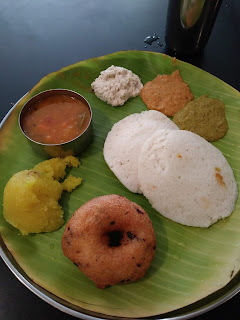
After a morning meeting or two via BlueJeans on side projects that are progressing stateside, I depart for the gym where I’m welcomed by Justin Bieber. “Let Me Love You” and “Despacito” are my fitness instructor’s favorite songs. He's had them on repeat for the past month and I secretly approve. After emerging from the sweatbox, breakfast is up one floor at “Temple City Family Restaurant.” Idly, dosa, vada, chutney, and Pongal complete the palate—South Indian food that’s both flavorful and fun to eat with your hands. I’m free entertainment for the wait staff who enjoy watching my unorthodox “shovel ‘n thrust technique.” I also have the dubious distinction of being the first person they've ever seen who's attempted to eat a soup with his fingers.
Off to work at 9am. I carpool with my neighbor, The Marvelous Mr. Selva. Despite the short distance, the commute always proves adventurous or, more accurately, treacherous. If a cat has 9 lives, everyone here has 900. My office is a glass palace—the home residence of the Chairman, a guru and gifted visionary. From nine to six I work on my core project and one of the Chairman’s top priorities—creating a coaching program for entrepreneurs in emerging economies. At 5:55 pm, as the sun slowly dips, the security guard kindly slips into my office to turn on my lights. At 6 pm, I kindly turn them off, pack my things, and depart for home.
I choose to walk home in order to stretch my legs and because nothing beats the thrill of a nightly near-death experience. Might is right on the roads in Madurai where pedestrians rank just above bugs on the commuter hierarchy scale. For dinner, I stuff as many mangoes in my face as humanly possible while squishing mosquitos so I don’t have to sleep with them. A little reading before bed, then repeat Monday through Saturday. Sundays are for letter writing (my favorite 19th century hobby), church (in Tamil), Bollywood flicks (“3 Idiots” is a must-see modern classic), and daydreaming of Culver’s Beef Butterburgers (something I must never admit aloud).
Parting Shot: The best part of my internship is the balance between autonomy and support from my project partner.


After a morning meeting or two via BlueJeans on side projects that are progressing stateside, I depart for the gym where I’m welcomed by Justin Bieber. “Let Me Love You” and “Despacito” are my fitness instructor’s favorite songs. He's had them on repeat for the past month and I secretly approve. After emerging from the sweatbox, breakfast is up one floor at “Temple City Family Restaurant.” Idly, dosa, vada, chutney, and Pongal complete the palate—South Indian food that’s both flavorful and fun to eat with your hands. I’m free entertainment for the wait staff who enjoy watching my unorthodox “shovel ‘n thrust technique.” I also have the dubious distinction of being the first person they've ever seen who's attempted to eat a soup with his fingers.
Off to work at 9am. I carpool with my neighbor, The Marvelous Mr. Selva. Despite the short distance, the commute always proves adventurous or, more accurately, treacherous. If a cat has 9 lives, everyone here has 900. My office is a glass palace—the home residence of the Chairman, a guru and gifted visionary. From nine to six I work on my core project and one of the Chairman’s top priorities—creating a coaching program for entrepreneurs in emerging economies. At 5:55 pm, as the sun slowly dips, the security guard kindly slips into my office to turn on my lights. At 6 pm, I kindly turn them off, pack my things, and depart for home.
I choose to walk home in order to stretch my legs and because nothing beats the thrill of a nightly near-death experience. Might is right on the roads in Madurai where pedestrians rank just above bugs on the commuter hierarchy scale. For dinner, I stuff as many mangoes in my face as humanly possible while squishing mosquitos so I don’t have to sleep with them. A little reading before bed, then repeat Monday through Saturday. Sundays are for letter writing (my favorite 19th century hobby), church (in Tamil), Bollywood flicks (“3 Idiots” is a must-see modern classic), and daydreaming of Culver’s Beef Butterburgers (something I must never admit aloud).
Parting Shot: The best part of my internship is the balance between autonomy and support from my project partner.
Pictures Below: 1. The glass palace. 2. South Indian breakfast. 3. My mustache (which I promptly shaved off despite it being the predominant style in India)
About the Author: Chris Owen is a rising second-year dual-degree student with the Ross School of Business and the School for Environment and Sustainability at the University of Michigan. He is passionate about social entrepreneurship, sustainability, and people strategy. He joins the 2018 WDI Global Impact Fellows program after serving for three years in Ecuador with the U.S. Peace Corps, first as a business consultant in the natural resource conservation program and then as a Regional Volunteer Leader.
About the Author: Chris Owen is a rising second-year dual-degree student with the Ross School of Business and the School for Environment and Sustainability at the University of Michigan. He is passionate about social entrepreneurship, sustainability, and people strategy. He joins the 2018 WDI Global Impact Fellows program after serving for three years in Ecuador with the U.S. Peace Corps, first as a business consultant in the natural resource conservation program and then as a Regional Volunteer Leader.


